
Type YHKGXSekFtlyn 3.6/6 kV Screened mining cables
Mining power cable, individually screened, copper core,
insulated with cross-linked polyethylene, sheathed with PVC, overall screen,
armoured with painted steel tape, with non-proliferation PVC jacket Flame
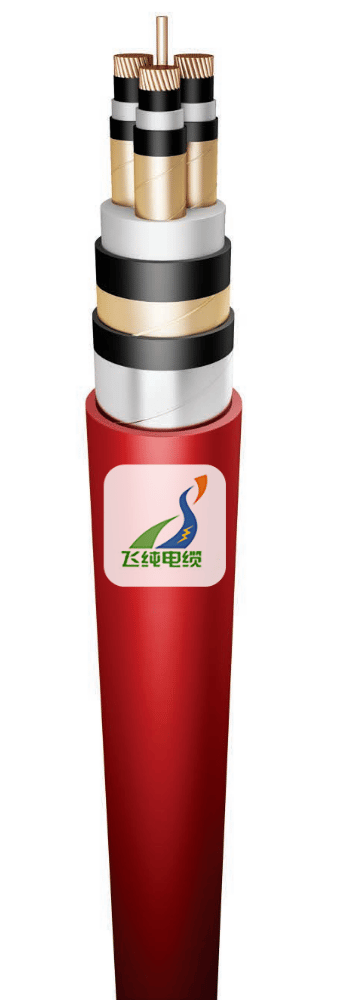
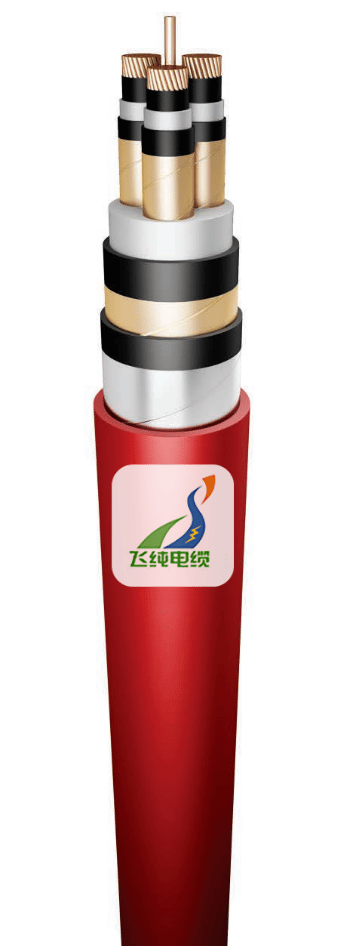
These cables are specially designed for underground mining power networks.
They are built to withstand harsh conditions, including high temperatures, potential short-circuit stresses, and explosive atmospheres (both methane and coal dust).
Although intended for mining installations, they are typically used in systems with a nominal voltage of up to 1 kV.
Construction Details
Conductors
Made of copper, each conductor is round, multi-stranded, and compacted (complying with EN 60228, Class 2).
Individual Screening
Each conductor is wrapped in its own screen. This is achieved using a layer of conductive tape (either metal-based or conductive polyethylene) combined with a copper tape. This helps reduce electromagnetic interference.
Insulation
The copper conductors are insulated with cross-linked polyethylene (XLPE) according to the PN-HD 620 S1:2002 standard.
Filler Layer
A filler layer, made of unvulcanized rubber or a tire-type polyvinyl compound (often referred to as “polwinit”), is used to fill the space between the insulated conductors and the inner sheath.
Inner Sheath
A PVC sheath (type DMV 31 per PN-HD 620 S1:2002) covers the insulated conductors and filler.
Overall Screen
An overall screen is applied, consisting of a copper tape wrapping, to further ensure electromagnetic compatibility.
Armour
The cable is armored with a layer of lacquered (painted) steel tape. This layer provides mechanical protection against impacts and abrasions.
Outer Jacket
Finally, the entire assembly is covered with a flame-retardant PVC outer jacket (also type DMV 31, with a tire-like appearance). This outer layer is red in color and helps prevent the spread of flames.
Key Characteristics
Temperature Ratings:
Operating (Normal Use): Up to +90 °C for the conductors.
Short-Circuit Conditions: Up to +250 °C.
Ambient Installation: Can be installed in fixed systems down to –30 °C, or even –50 °C during installation (without heating).
Mechanical Flexibility:
The minimum bending radius is 12 times the cable’s overall diameter (12×D).
Electrical Test Voltage:
Each cable is tested at 15 kV AC for 5 minutes (50 Hz).
Flame Propagation:
The cable meets IEC flame spread standards (IEC 60332-1-2 and IEC 60332-3-24C).
Tensile Strength:
Maximum pulling force is calculated as 50 times the total cross-sectional area of the conductors (50×S, where S is in mm²).
Applications
These cables are intended for use in underground mining settings:
Suitable for both methane and non-methane areas.
Approved for zones with explosion risks (methane class A or B and coal dust hazards).
Although the system voltage is typically up to 1 kV in mining installations, these cables (rated at 3.6/6 kV) are built robustly for such demanding environments.
Certifications
The cable holds certifications such as EMAG and WUG.
It complies with RoHS requirements.
Temperature limits for certification are typically +90 °C (max) and –5 °C (min) for the overall cable.
Technical Data (Summarized)
Cable Variants:
Available in different sizes/configurations (e.g., 3×25 mm², 3×35 mm², up to 3×240 mm²). Each variant has specific insulation, sheath, and screen thicknesses along with overall diameter and weight per kilometer.
Electrical Properties:
Tables (not shown here) provide details on:Maximum conductor resistance at 20 °C.
Current-carrying capacities (ampacity) for various conductor sizes.
Unit inductance and inductive reactance.
Installation Adjustments:
When cables are laid in parallel (stacked on top of each other), a correction factor must be applied to the current-carrying capacity.
Additional correction factors are used if the ambient temperature exceeds +25 °C (for example, at 30 °C the capacity is reduced to 96% of the rated value, and at 55 °C it is 73%).
Packaging:
Standard packaging lengths are 500 or 1000 meters per drum, although custom lengths and packaging options are available.

Frequently Asked Questions (FAQ)
Q: What is the Type YHKGXSekFtlyn cable?
A: It’s a specially designed screened mining power cable intended for underground installations in harsh mining environments.
Q: What voltage rating does this cable have?
A: The cable is rated for 3.6/6 kV applications, making it suitable for medium-voltage power distribution in mines.
Q: What are the main construction features of the cable?
A: It features copper multi-stranded conductors with individual screening, XLPE insulation, an overall copper tape screen, steel tape armor, and a flame-retardant PVC outer jacket.
Q: How does the cable ensure safety in explosive mining atmospheres?
A: The cable is approved for use in methane and coal dust explosive atmospheres, meeting strict safety standards (explosion class A or B), and its flame-retardant outer jacket minimizes fire spread.
Q: What insulation material is used in the cable?
A: The conductors are insulated with cross-linked polyethylene (XLPE), which provides excellent thermal resistance and long-term stability under high temperatures.
Q: How is electromagnetic interference (EMI) reduced in this cable?
A: EMI is minimized through individual conductor screening and an overall screen made of copper tape, ensuring stable electrical performance even in noisy environments.
Q: What mechanical protection does the cable offer?
A: The cable includes a robust steel tape armor and a durable PVC sheath that protect it from physical damage, impacts, and abrasions typical in mining operations.
Q: What is the minimum bending radius for this cable?
A: The minimum bending radius is 12 times the overall cable diameter (12×D), ensuring that bending during installation does not damage the cable.
Q: How is the cable tested for electrical integrity?
A: It undergoes a high-voltage test of 15 kV AC for 5 minutes at 50 Hz to verify insulation quality and reliability under stress.
Q: What operating temperature range can this cable withstand?
A: It can operate at conductor temperatures up to +90 °C normally, handle short-circuit temperatures up to +250 °C, and is suitable for ambient installation temperatures as low as –30 °C (or –50 °C during installation).
Q: Are there standard packaging options available?
A: Yes, the cable is typically available in lengths of 500 or 1000 meters per drum, with custom lengths and packaging options available upon request.
Q: What certifications does this cable hold?
A: It meets certifications such as EMAG and WUG, complies with RoHS requirements, and adheres to IEC flame propagation standards (IEC 60332-1-2 and IEC 60332-3-24C).
Q: In what types of mining installations is this cable typically used?
A: It is used in underground mining power networks, both in methane and non-methane environments, ensuring safe electrical distribution in areas with explosion risks.
Q: How does the cable’s XLPE insulation benefit its performance?
A: XLPE insulation provides high thermal endurance, excellent electrical properties, and long-term stability, which is crucial in the high-temperature conditions found in mining operations.
Q: How do installation conditions affect the cable’s current-carrying capacity?
A: When installed in parallel or stacked configurations, correction factors must be applied to the cable’s ampacity to account for reduced heat dissipation.
Q: What role does the overall copper tape screen play?
A: The overall screen minimizes electromagnetic interference, ensuring that the cable delivers stable and efficient power transmission in electrically noisy mining environments.
Q: Can the cable be used for both fixed and temporary mining installations?
A: While it is primarily designed for fixed underground installations, it can be adapted for temporary setups if installation guidelines, such as bending radius and stacking corrections, are followed.
Q: What measures are in place to protect the cable during installation in harsh mining environments?
A: The robust construction, including flame-retardant PVC and steel tape armor, along with its individual screening and insulation design, ensures durability against mechanical stresses and environmental hazards.
Q: How is the cable’s conductor constructed?
A: The conductors are made from compacted, multi-stranded copper wires (EN 60228 Class 2) that provide excellent conductivity and flexibility for rugged installation conditions.
Q: What maintenance or inspection procedures are recommended for this cable in mining sites?
A: Regular inspections should be conducted to check for physical damage, proper stacking, and adherence to the specified bending radius. It’s also important to monitor the installation environment for temperature and potential mechanical stresses.
Q: How does the cable perform in terms of electrical resistance and efficiency?
A: Detailed technical tables provide information on the cable’s resistance, inductance, and reactance at 20 °C, ensuring efficient power transmission with minimal losses even under heavy load conditions.


Type YHKGXSekFtlyn 3.6/6 kV Screened mining cables
Type YHKGXSekFtlyn 3.6/6 kV mining cable is designed specifically for challenging underground mining environments. It features individually screened, multi-stranded copper conductors insulated with cross-linked polyethylene (XLPE) for excellent thermal and electrical performance. An overall copper tape screen minimizes electromagnetic interference, while a robust steel tape armor and flame-retardant PVC outer jacket protect against mechanical damage and fire hazards. Rated for operation up to +90°C (and short-circuit conditions up to +250°C), this cable meets strict safety standards for explosive atmospheres, making it an ideal choice for reliable power distribution in mining applications.
6/30/20216 min read