
Type YHKGXFpyn Mining Cable 0.6/1 kV
Electric power cable, mining, with copper working conductors, in an individual radial field screen, with cross-linked polyethylene insulation, in a PVC sheath, armoured with flat steel wires, in a flame retardant PVC sheath
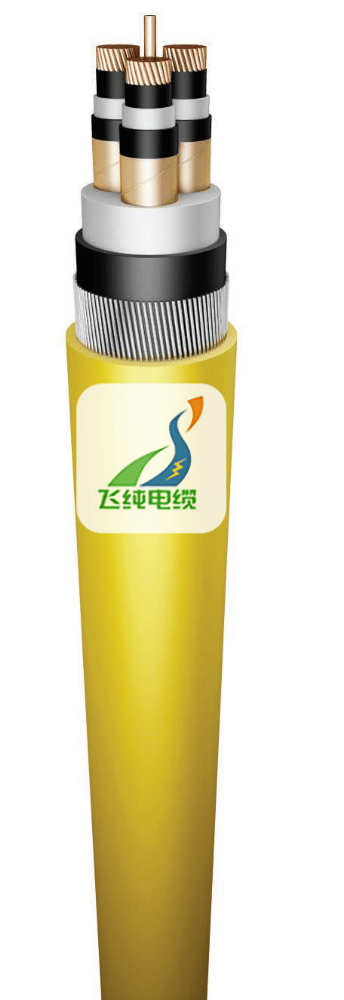
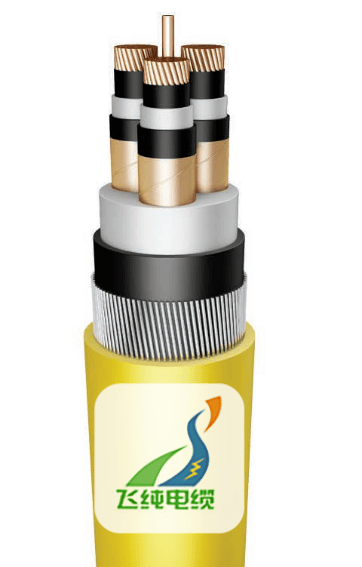
This mining cable is designed for underground electrical installations in mining facilities.
It operates at low voltage (up to 1 kV) and is built to perform safely in harsh, potentially explosive environments (both methane and coal-dust risks).
Construction
The cable is made with multiple layers for safety and durability:
Conductors:
Made of copper.
They are round, multi-stranded, and compacted (Class 2 per EN 60228).
Insulation:
Uses cross-linked polyethylene (XLPE) for excellent electrical insulation and thermal resistance.
The insulation type is DIX 5, complying with PN-HD 603 S1:2002.
Screening:
Each conductor is individually wrapped with a radial semiconducting tape screen.
This screen may include an extruded layer plus copper wire and copper tape for improved performance.
Inner Sheath:
A PVC layer (DMV 6 per PN-HD 603 S1:2002) covers the insulated conductors.
Armour:
Reinforced with flat steel wires (FeZn) to protect against mechanical damage.
Outer Sheath:
A flame-retardant PVC (tire-type DMV 6) provides the final protective layer, limiting flame spread.
The cable meets the Polish standard ZN-TF 205:2006.
Key Characteristics
Temperature Ratings:
Operating Temperature: Up to +90°C (conductor temperature during normal use).
Short-Circuit Temperature: Can reach up to +250°C during a short circuit.
Ambient Installation Temperature: Can be installed in environments as low as -30°C (if permanently laid) and as low as -50°C when laying without pre-heating.
Mechanical Properties:
Bending Radius: Must not be bent to a radius less than 12 times the cable’s overall diameter.
Tensile Strength: The maximum pulling force is 50 times the sum of the conductor cross-sectional areas.
Electrical Testing:
Test Voltage: 4 kV AC is applied for 5 minutes at 50 Hz to ensure integrity.
Flame Resistance:
Complies with IEC standards (IEC 60332-1-2 and IEC 60332-3-24C) to limit the spread of flames.
Packaging:
Typically delivered in 500 or 1000-meter drums, with other lengths and packaging options available.
Cable Sizes & Ratings
The cable is available in various sizes (for example, 3x16 mm², 3x25 mm², 3x35 mm², 3x50 mm², 3x70 mm², 3x95 mm², 3x120 mm², 3x150 mm², 3x185 mm²). Each variant has specific parameters including:
Layer Thicknesses:
Insulation, inner sheath, and armour thicknesses are precisely defined.
Overall Diameter & Weight:
Each size has an approximate overall diameter and weight per kilometer.
Conductor Resistance:
Maximum resistance values are provided (measured at 20°C).
There is also a table of electrical properties showing:
Current-Carrying Capacity:
For example, a 16 mm² conductor can carry about 104 A, and larger conductors carry more.
Inductance & Reactance:
Unit values (in mH/km and Ω/km) are specified for each conductor size.
Installation Considerations:
Parallel Installation:
When cables are installed in parallel (stacked on supports), the current capacity must be derated using correction factors (e.g., 0.93 for 2 cables, 0.90 for 3, etc.).
Ambient Temperature Effects:
For ambient temperatures above 25°C, additional correction factors apply (e.g., 0.96 at 30°C, decreasing to 0.73 at 55°C).
Applications
This cable is specifically designed for:
Underground Mining Installations:
Suitable for electrical networks in mines with nominal voltages up to 1 kV.
Hazardous Areas:
Approved for use in both methane and non-methane zones, including mine workings with varying degrees of explosion risk.
Steep Installations:
Armored versions (using flat or round steel wires) are suitable for inclined mine galleries (installations above a 45° slope).

Frequently Asked Questions (FAQ)
What is the Type YHKGXFpyn Mining Cable 0.6/1 kV?
Answer:
It is a low-voltage electric power cable specifically engineered for underground mining installations. The cable is designed to withstand harsh conditions, including explosive atmospheres and mechanical stresses common in mining environments.What are the key construction features of this cable?
Answer:
The cable is built with multiple layers for enhanced performance and safety:Conductors: Copper, round, multi-stranded, and compacted per EN 60228.
Insulation: Cross-linked polyethylene (XLPE) that offers high thermal and electrical resistance.
Screening: Individual radial semiconducting screens that ensure even voltage distribution.
Inner Sheath: A PVC layer (DMV 6) protecting the insulated conductors.
Armour: Flat steel wires providing robust mechanical protection.
Outer Sheath: A flame-retardant PVC cover that limits flame spread.
Which standards does this cable comply with?
Answer:
It meets the Polish Standard ZN-TF 205:2006 and adheres to international flame resistance standards such as IEC 60332-1-2 and IEC 60332-3-24C, ensuring it is safe for use in explosive environments.In what types of mining environments can this cable be used?
Answer:
The cable is designed for underground mining networks, suitable for both methane and non-methane zones. It can be used in areas with different levels of explosion risk, including mines prone to explosive coal dust and methane accumulations.How does the cable perform under extreme temperatures?
Answer:
The cable is robust in various thermal conditions:Normal Operation: Conductor temperature can reach up to +90°C.
Short-Circuit Conditions: Temperatures can peak at +250°C.
Ambient Conditions: It is rated for environments as low as -30°C when permanently installed, and down to -50°C during installation without pre-heating.
What mechanical protection does the cable offer for mining applications?
Answer:
Its flat steel wire armour provides excellent protection against physical impacts, abrasions, and other mechanical stresses encountered in mining operations, making it ideal for harsh underground conditions.Why are individual radial semiconducting screens important?
Answer:
These screens ensure that electrical stress is evenly distributed around each conductor. This design reduces the risk of electrical faults and enhances overall cable performance in the electrically demanding and explosive-prone environments of mining.What installation requirements must be followed for this cable?
Answer:
Key installation considerations include:Maintaining a minimum bending radius of 12 times the cable’s overall diameter.
Applying correction factors for current-carrying capacity when multiple cables are installed in parallel.
Ensuring proper cable spacing and routing to facilitate adequate heat dissipation and prevent mechanical damage.
What are the available packaging options for this cable?
Answer:
The cable is typically supplied in 500 or 1000-meter drums. However, customized lengths and packaging configurations are available to meet the specific demands of different mining projects.How does the cable’s flame-retardant design contribute to mining safety?
Answer:
The flame-retardant PVC outer sheath is designed to inhibit the spread of flames, which is crucial in hazardous mining environments. This property, in conjunction with compliance to IEC flame-resistance standards, minimizes fire risks in explosive atmospheres.What makes this cable particularly suitable for use in explosive mining areas?
Answer:
Its construction—combining robust copper conductors, durable XLPE insulation, individually screened layers, and a flame-retardant, armored sheath—ensures reliable performance and high safety margins.This makes it ideal for the challenging conditions encountered in underground mining, where both electrical and mechanical hazards are present.


Type YHKGXFpyn Mining Cable 0.6/1 kV
This 0.6/1 kV mining cable is built for tough underground conditions. It features compacted, multi-stranded copper conductors insulated with high-performance cross-linked polyethylene (XLPE). Each conductor is individually screened with a radial semiconducting layer for even voltage distribution. An inner PVC sheath, a robust flat steel wire armor, and an outer flame-retardant PVC jacket provide excellent mechanical protection and fire resistance. Compliant with Polish and international standards, this cable is ideally suited for hazardous mining environments, including areas with explosive methane and coal dust.
6/30/20215 min read